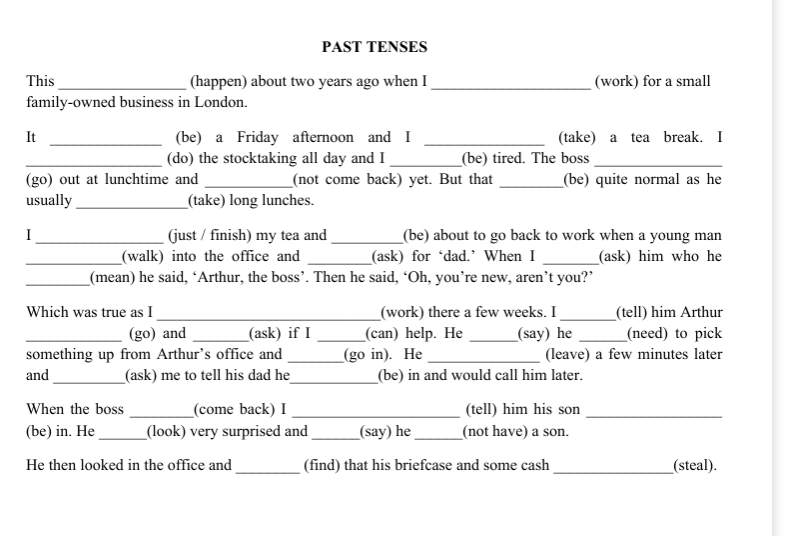
Задача 80527 Rewrite the story, fill in the proper...
Условие

Решение
1. the completed story,
2. every finite verb underlined,
3. the name of its tense in brackets, and
4. the time-indicator (or other clue) that helped to choose that tense.
––––––––––––––––––––––––––––––––––––––––––––––––––––––––––
This __happened__ (Past Simple – “about two years ago”) about two years ago when I __was working__ (Past Continuous – background action introduced by “when”) for a small family-owned business in London.
It __was__ (Past Simple – statement of fact) a Friday afternoon and I __was taking__ (Past Continuous – action in progress “a tea break”) a tea break.
I __had been doing__ (Past Perfect Continuous – duration “all day”) the stock-taking all day and I __was__ (Past Simple) tired.
The boss __had gone__ (Past Perfect – earlier past action “at lunchtime”) out at lunchtime and __hadn’t come__ (Past Perfect – “yet”) back yet, but that __was__ (Past Simple) quite normal as he usually __took__ (Past Simple – repeated past habit “usually”) long lunches.
I __had just finished__ (Past Perfect – “just”) my tea and __was__ (Past Continuous – still in progress) about to go back to work when a young man __walked__ (Past Simple – sudden new action) into the office and __asked__ (Past Simple) for “Dad”.
When I __asked__ (Past Simple) him who he __meant__ (Past Simple) he said, “Arthur, the boss.” Then he said, “Oh, you’re new, aren’t you?”
Which was true, as I __had been working__ (Past Perfect Continuous – “a few weeks”) there only a few weeks.
I __told__ (Past Simple) him Arthur __had gone__ (Past Perfect) and __asked__ (Past Simple) if I __could__ (Past form of the modal “can”) help.
He __said__ (Past Simple) he __needed__ (Past Simple – reported speech) to pick something up from Arthur’s office and __went__ (Past Simple) in.
He __left__ (Past Simple) a few minutes later and __asked__ (Past Simple) me to tell his dad he __had been__ (Past Perfect – earlier than “asked”) in and would call him later.
When the boss __came__ (Past Simple – time clause “when”) back, I __told__ (Past Simple) him his son __had been__ (Past Perfect) in.
He __looked__ (Past Simple) very surprised and __said__ (Past Simple) he __didn’t have__ (Past Simple negative) a son.
He then __looked__ (Past Simple) in the office and __found__ (Past Simple) that his brief-case and some cash __had been stolen__ (Past Perfect Passive – action completed before “found”).
––––––––––––––––––––––––––––––––––––––––––––––––––––––––––
Summary of the main time indicators
• about two years ago – finished point in past → Past Simple
• when + another past action – background → Past Continuous
• all day, a few weeks – duration up to a moment → Past Perfect Continuous
• yet, already, just, earlier past reference – Past Perfect / Past Perfect Passive
• usually – past habit → Past Simple
• sudden new action interrupting a background action – Past Simple vs. Past Continuous