Задача 80375 Решить на английском ...
Условие

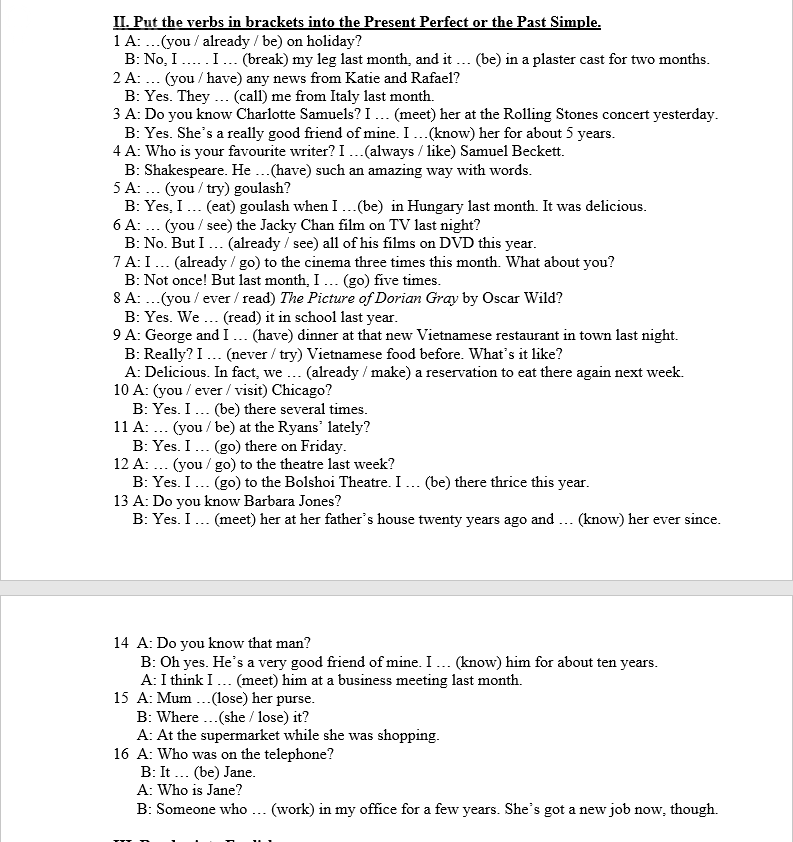
Решение
1 A: Have you already been on holiday?
B: No. I broke my leg last month, and it has been in a plaster cast for two months.
• “Have … been” – life experience, no exact time.
• “broke / has been” – the break happened at a clear time (last month); the leg is still in plaster now, so the result continues.
2 A: Have you had any news from Katie and Rafael?
B: Yes. They called me from Italy last month.
• Present perfect for recent news without giving the time; past simple for an action at a stated time (last month).
3 A: … I met her at the Rolling Stones concert yesterday.
B: … I have known her for about five years.
• “met” – yesterday = finished past action.
• “have known” – the friendship started in the past and is still true.
4 A: I have always liked Samuel Beckett.
B: Shakespeare had such an amazing way with words.
• “have always liked” – emotion starting in the past and still true.
• “had” – refers to Shakespeare’s style in his lifetime (finished past period).
5 A: Have you ever tried goulash?
B: Yes, I ate goulash when I was in Hungary last month.
• “Have tried” – life experience.
• “ate / was” – finished, clearly-dated visit.
6 A: Did you see the Jackie Chan film on TV last night?
B: No. But I have already seen all of his films on DVD this year.
• “Did you see” – last night = finished time.
• “have already seen” – the period “this year” has not finished.
7 A: I have already been to the cinema three times this month. What about you?
B: Not once! But last month I went five times.
• “have been” – “this month” is still open.
• “went” – last month = closed period.
8 A: Have you ever read The Picture of Dorian Gray by Oscar Wilde?
B: Yes. We read it in school last year.
• Experience with no time versus an activity at a definite past time.
9 A: George and I had dinner at that new Vietnamese restaurant in town last night.
B: Really? I have never tried Vietnamese food before. What’s it like?
A: Delicious. In fact, we have already made a reservation to eat there again next week.
• “had” – last night.
• “have never tried / have already made” – life experience & recent action whose result matters now.
10 A: Have you ever visited Chicago?
B: Yes, I have been there several times.
• Unspecified past experiences, still relevant.
11 A: Have you been to the Ryans’ lately?
B: Yes. I went there on Friday.
• “lately” → present perfect; “on Friday” → past simple.
12 A: Did you go to the theatre last week?
B: Yes. I went to the Bolshoi Theatre. I have been there three times this year.
• “Did … last week” – finished time; “have been … this year” – continuing period.
13 A: Do you know Barbara Jones?
B: Yes. I met her at her father’s house twenty years ago and have known her ever since.
• First action finished long ago; the state of knowing continues.
14 A: Do you know that man?
B: Oh yes. He’s a very good friend of mine. I have known him for about ten years.
A: I think I met him at a business meeting last month.
• Present perfect for the on-going friendship; past simple for the one-off meeting.
15 A: Mum has lost her purse.
B: Where did she lose it?
A: At the supermarket while she was shopping.
• “has lost” – the purse is still missing now; “did she lose” – asking about the past event.
16 A: Who was on the telephone?
B: It was Jane.
A: Who is Jane?
B: Someone who worked in my office for a few years. She’s got a new job now, though.
• “was” – finished phone call; “worked” – she no longer works there, so past simple.