Задача 80374 Решить на английском...
Условие

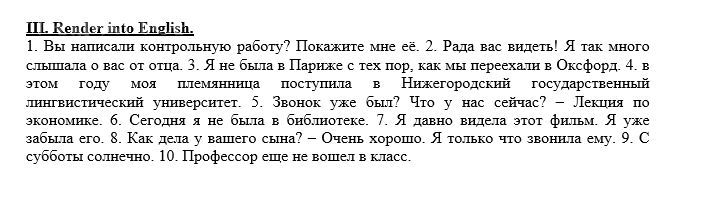
Решение
(After each sentence the tense or form is briefly explained.)
1. Have you written the test (paper) yet? Show it to me.
– Present Perfect is used for a recently completed action that has a present result (“you can show it to me”).
2. I’m glad to see you! I’ve heard so much about you from my father.
– Present Perfect for an experience that is still relevant at the moment of speaking.
3. I haven’t been to Paris since we moved to Oxford.
– Present Perfect + “since” + Past Simple expresses a situation that began in the past and continues up to now.
4. This year my niece has entered (has been admitted to) Nizhny Novgorod State Linguistic University.
– Present Perfect is preferred with the time-adverbial “this year” when the year has not finished yet.
5. Has the bell rung yet? What do we have now? — An economics lecture.
– Present Perfect (“has … rung”) for an action with an immediate result; Present Simple (“we have”) for a timetable/regularly scheduled event.
6. I haven’t been to the library today.
– Present Perfect with the unfinished time-period “today”.
7. I saw that film a long time ago. I’ve already forgotten it.
– Past Simple for a finished past event with a definite past time (“a long time ago”); Present Perfect for the present result (“I no longer remember it”).
8. How is your son? — Very well. I’ve just phoned him.
– Present Perfect with “just” for a very recent action.
9. It has been sunny since Saturday.
– Present Perfect Continuous idea (here in simple form with “been”) for a state that began in the past and is still true.
10. The professor hasn’t come into the classroom yet. / The professor hasn’t entered the class yet.
– Present Perfect + “yet” for an action expected but not completed by the present moment.